

Jujutsu Kaisen has finally ended, and not everyone is happy with the vision the writer Gege Akutami has on its ending. The popular anime is well-known more for its character rather than the story itself, like Gojo Satarou, Nanami Kento, and Suguru Geto, etc. The whole fanbase around the world mourns the unjustified death of Gojo Satarou even to the point that the fandom split into Gojo vs. Sukuna fan. With writing, we can judge that writer favored Sukuna over Gojo and gave very much rise to the debate of plot armor favoritism.

Although Ryomen Sukuna as a curse is a fictional character, as said, to be a fictional character, it must have had its inspiration from somewhere. There comes Japanese folklore, infact, Ryomen Sukuna, as the person, has presence in folklore of Japan, first appearing in the The Nihon Shoki (日本書紀) – translated as The Chronicles of Japan, which is the second-oldest book of classical Japanese history. He was mentioned as a two-faced and not a law-abiding person who was sentenced to death by the imperial order. In another lore, he is said to be the founder of a tiny Senkou Temple and had a good reputation during the Heian era.
In another story from 1621, during Nintoku’s rule, a person Sukuna came out of a cave in Dewa ga hira. He was 18 meters tall and had two faces, four arms, and four legs and believed to be incarnation of Bodhisattva Kannon. As a result, ordered by the emperor to kill Shichinō – a oni, who believed to be lived near Mount Iyama in Takayama City. There are lots of references to the name Sukuna in Japanese history – in one he’s is said to be a rich local town person who happened to left the town to live on sacred Mt Kinzan in fear of being murdered. In another version, he stayed on there for 37 days and prayed for the well-being of the nation. Nevertheless, the lores are filled with myths where he said to defeat dragons and grew thousands of cypress trees by stabbing a staff into the ground. Most of the lores seem to depict Sukuna in a positive light, but a story from Taisho Era has somewhat interesting to tell, a mysterious 2M dark wooden box with a rugged paper on top written – Ryomen Sukuna.
The story during Taisho Era in Iwate Prefecture had become a part of urban legend as the involved faced a ill luck in their lives as told by many. The story revolves around a mysterious wooden box, ordered not to be opened until a certain person arrives on the scene. But, unfortunately, the box was already opened by two workers because of some miscommunication, and they seemed to be unresponsive when the concerned person arrived at the scene with a monk. The monk performed some purification ritual on both, but unfortunately, one died in a suspicious manner, and the other one somehow ended up in a psychiatric ward. The manager did some digging and found that this Sukuna belonged to people called Sukuna-zoku who refused the rule of the emperor and were wiped out. Similarly, in another version from Taisho Era, a pair of conjoined twins was used as a vessel to deliver a curse over the nation that seems to have brought calamities for more than a decade.
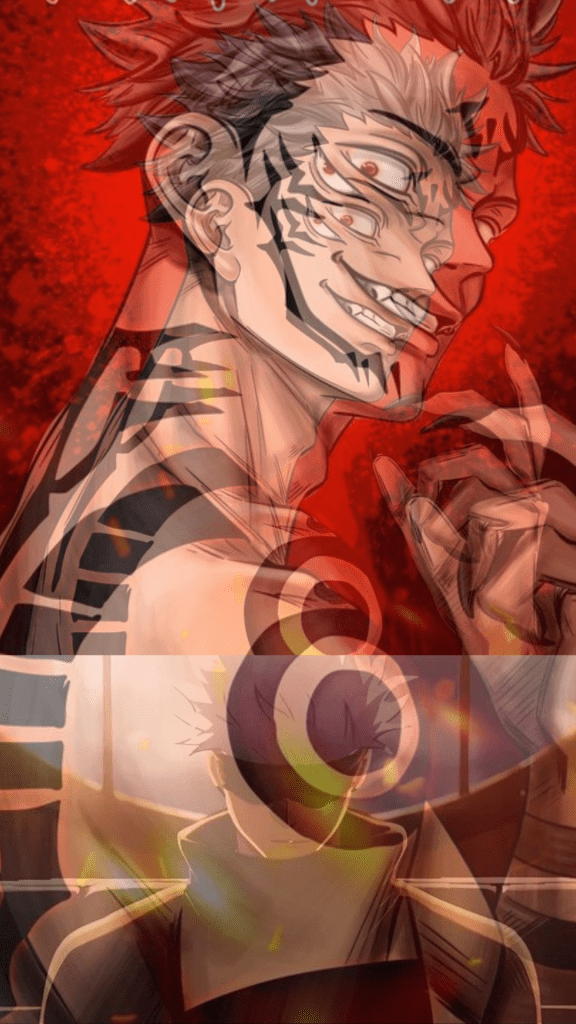
From the above lores, it can’t be evidently said that Sukuna was an evil figure but sure has lots of content and stories to provide base for fictional Sukuna character that the audience see in Manga and anime. The depiction that he has in the story seems heavily inspired as well. It is hard to decipher why Gege Akutami chose to go with the negative side of Sukuna? Maybe Sukuna makes more sense as a deranged evil villain than a good character. Nevertheless, Gege has given us evil but amazing characters like Kenjaku, Uraume, and unforgettable Mahito equally balanced with top-notch characters like Nanami Kento, Toji, the Yuji-Megumi-Nobara trio and of course Gojo Satrou.
 Animexon